Projects
Systems I have designed, built and evaluated end to end. Each one links to a full writeup with the method, the figures and the numbers.
Heterogeneous Trajectory Prediction and Social Navigation
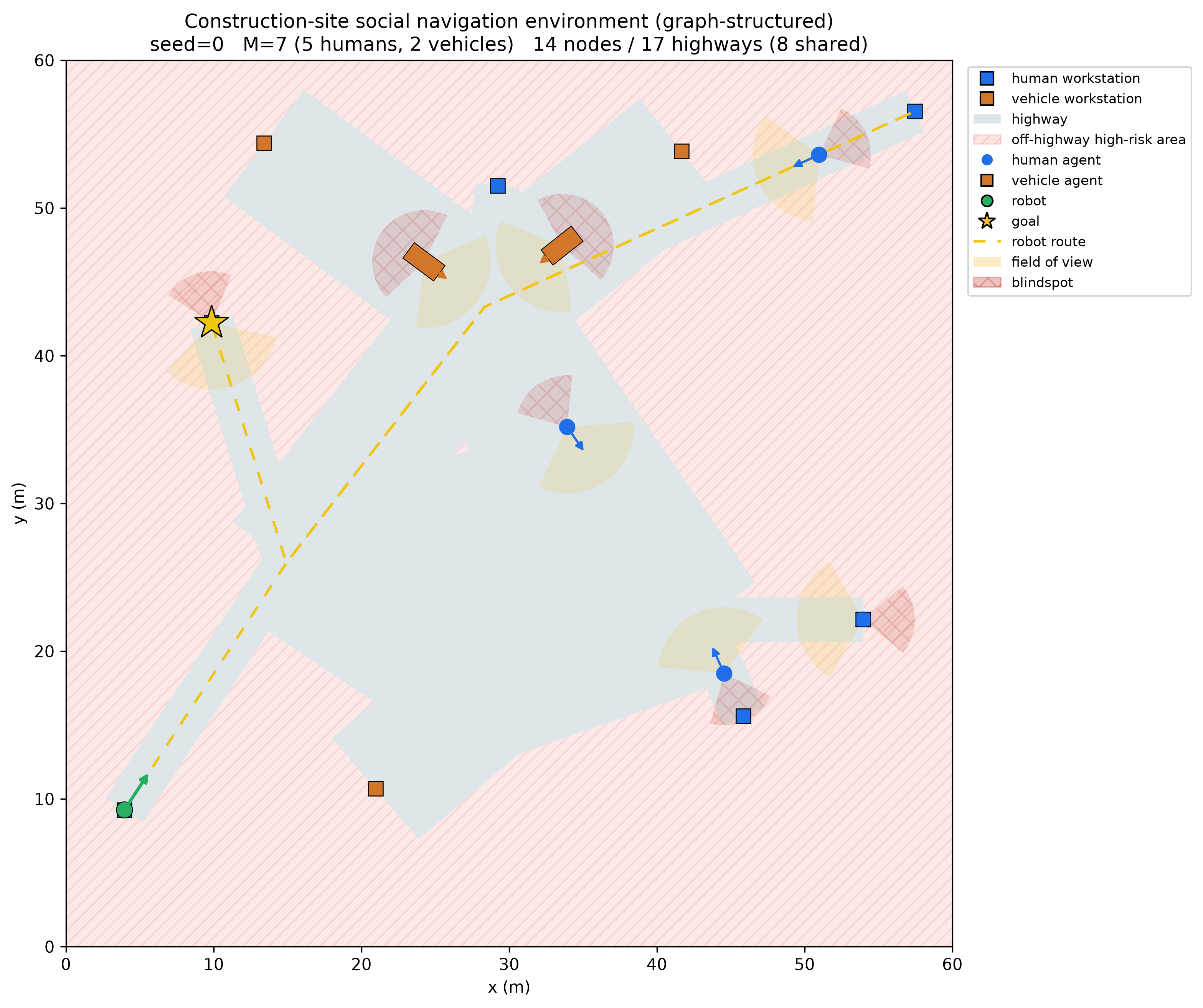
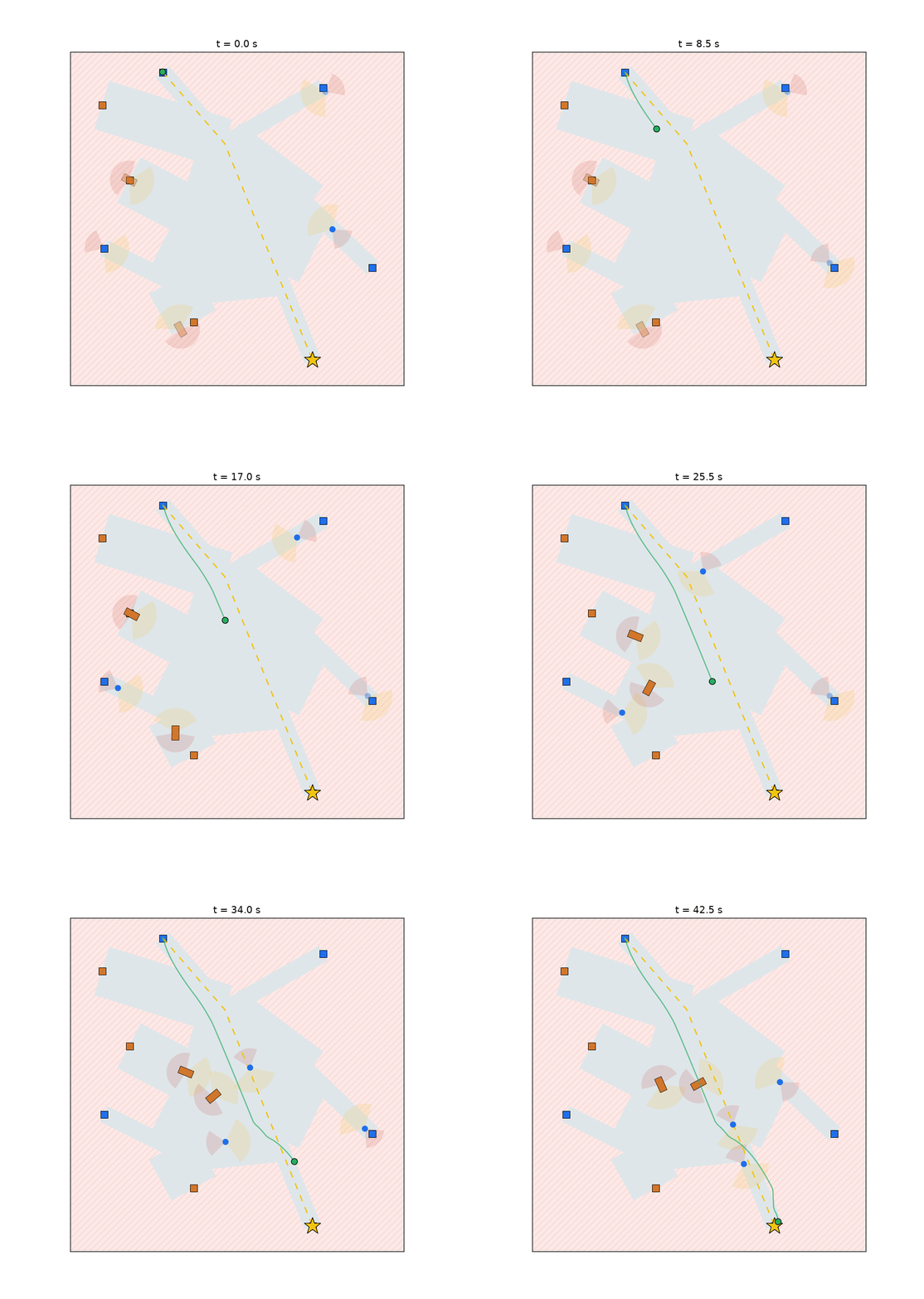
A robot has to reach workstations across a construction site shared with 5–19 people and heavy vehicles. The agents are not a generic crowd: workers are unicycles that stop and turn on the spot, site vehicles are bicycles with a 4.3 m turning circle that keep their path, and humans yield to vehicles — so the robot has to satisfy the safety constraint alone. I built the closed-loop simulator, three predictors (constant velocity, a reduced Trajectron++, and a MotionDiffuser-style diffusion model) and a joint predictor–planner that applies safety constraints inside reverse diffusion rather than after it.
The planner reaches its goals in 100 % of randomized trials, and the comparison against ORCA and perfect-knowledge references isolates what prediction actually buys: not fewer collisions, but distance. The same system runs on the Georgia Tech Robotarium with every agent instantiated as a physical-style robot.